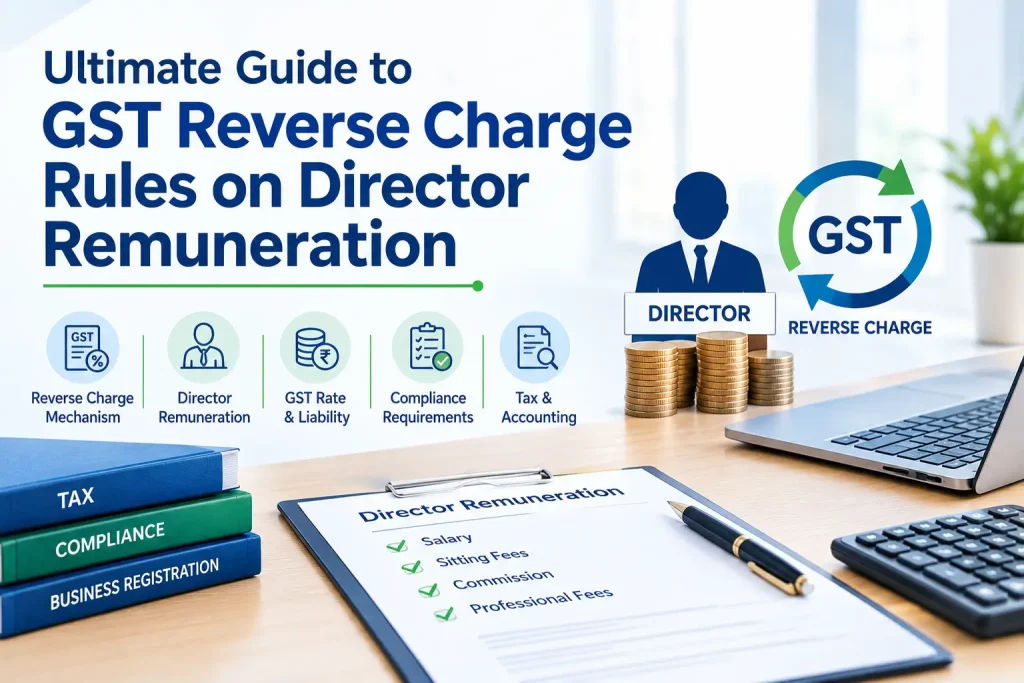
Director remuneration is an important compliance area for companies in India. Businesses may pay salaries, sitting fees, commissions, or professional fees to their directors. However, the Goods and Services Tax (GST) treatment of these payments depends on the nature of the services and whether the director acts as an employee or in an independent capacity.
Under applicable GST provisions, companies may need to pay GST under the Reverse Charge Mechanism (RCM) on certain payments made to directors. Understanding these rules helps businesses avoid incorrect tax treatment, reporting errors, and compliance issues.
This guide explains the key rules, applicable situations, and practical steps companies should follow when reviewing GST on director remuneration.
What Is the Reverse Charge Mechanism Under GST?
The Reverse Charge Mechanism is a system under which the recipient of specified goods or services is responsible for paying GST instead of the supplier. It applies to categories of transactions notified under GST law.
For director remuneration, the relevant provisions include Notification No. 13/2017 Central Tax (Rate) and CBIC Circular No. 140/10/2020 GST, dated 10 June 2020. The circular clarifies how GST applies to remuneration paid to independent directors and directors who are also employees of a company.
Companies must therefore examine the nature of each payment before deciding whether GST under RCM applies.
Is GST Applicable on Director Remuneration?
GST treatment generally depends on whether the remuneration relates to an employer and employee relationship or services provided independently by a director.
- Remuneration paid to independent directors
Independent directors are generally not employees of the company. Remuneration paid to them for their services, including applicable sitting fees or commission, is taxable under RCM, and the company receiving the services is responsible for paying the applicable GST.
- Remuneration paid to employee directors
A whole-time director or managing director may also work as an employee of the company. Where the remuneration is genuinely paid as salary under an employer-employee relationship, it is outside the scope of GST under Schedule III of the CGST Act.
However, a director may perform separate services in an independent capacity. Payments for those services may attract GST under RCM, depending on their nature and the applicable provisions. The classification should be supported by employment agreements, payment records, and relevant documentation.
How to Determine the Correct GST Treatment?
Companies should not classify director remuneration based only on the director’s designation. The actual relationship, duties performed, employment agreement, and accounting treatment should be reviewed.
For example, if a managing director receives salary under an employment arrangement, that salary is generally outside GST. If the same director receives separate professional fees for services provided in an independent capacity, the additional payment requires a separate GST assessment.
The CBIC circular also distinguishes between remuneration recorded as salary and subjected to TDS under Section 192 of the Income Tax Act, 1961, and professional or technical fees subjected to TDS under Section 194J. The corresponding GST treatment should be assessed using the applicable provisions for the relevant period.
What Is the Applicable GST Rate?
Where director services are taxable under RCM, the applicable GST rate must be determined according to the relevant service classification and prevailing rate notifications. Director services commonly attract GST at 18%, subject to the applicable classification and legal provisions.
For intra-state supplies, the applicable tax is generally divided into CGST and SGST. For inter-state supplies, IGST may apply. Companies should verify the place of supply and nature of the transaction before reporting the liability.
The company should also check whether the GST paid is eligible for Input Tax Credit. Credit is not automatic merely because tax has been paid under RCM. The applicable eligibility conditions and restrictions under GST law must be satisfied.
GST Compliance Steps for Companies
Businesses should establish a consistent process for identifying and reporting director remuneration. The following steps can help maintain accurate records.
- Review director agreements: Identify whether the payment relates to employment or independent services.
- Classify remuneration: Separate salary from sitting fees, commission and professional fees where applicable.
- Calculate GST liability: Determine the taxable value, applicable rate and place of supply.
- Pay GST under RCM: Discharge the liability within the applicable statutory timelines.
- Report the transaction: Include the liability in the appropriate GST returns and maintain supporting records.
- Review Input Tax Credit: Claim eligible credit only after checking the applicable conditions.
Companies looking for GST Filing Services Near Me can benefit from professional assistance with return preparation, reconciliation, and the reporting of applicable RCM liabilities.
Common Mistakes to Avoid
Some companies assume that all payments made to directors are exempt from GST because the recipients hold directorship positions. Others apply RCM to every payment without checking whether the remuneration is genuinely salary under an employer-employee relationship.
Other common mistakes include incorrect classification of sitting fees, failure to report RCM liabilities, unsupported Input Tax Credit claims, and mismatches between financial records and GST returns.
Regular reviews with a qualified GST Consultant in Ahmedabad can help businesses identify these issues, maintain supporting documents, and improve the accuracy of their GST reporting.
How Professional Tax and Accounting Support Helps
Director remuneration often involves coordination between company law, payroll, taxation and GST reporting. Businesses should maintain clear employment agreements, board approvals, remuneration records and supporting accounting entries.
Professional Accounting Services Ahmedabad can help businesses organise financial records, reconcile remuneration payments and review their accounting treatment. Companies should also assess their wider statutory responsibilities to ensure that applicable compliance requirements are addressed.
Conclusion
GST on director remuneration depends primarily on the nature of the services and the relationship between the director and the company. Remuneration paid to independent directors and directors acting in an independent capacity generally attracts GST under RCM, while genuine salary paid to employee directors is generally outside GST.
Companies should review each payment carefully, maintain supporting documentation, and ensure that applicable GST liabilities are paid and reported correctly. Professional guidance can help businesses manage these requirements and reduce the risk of compliance errors.