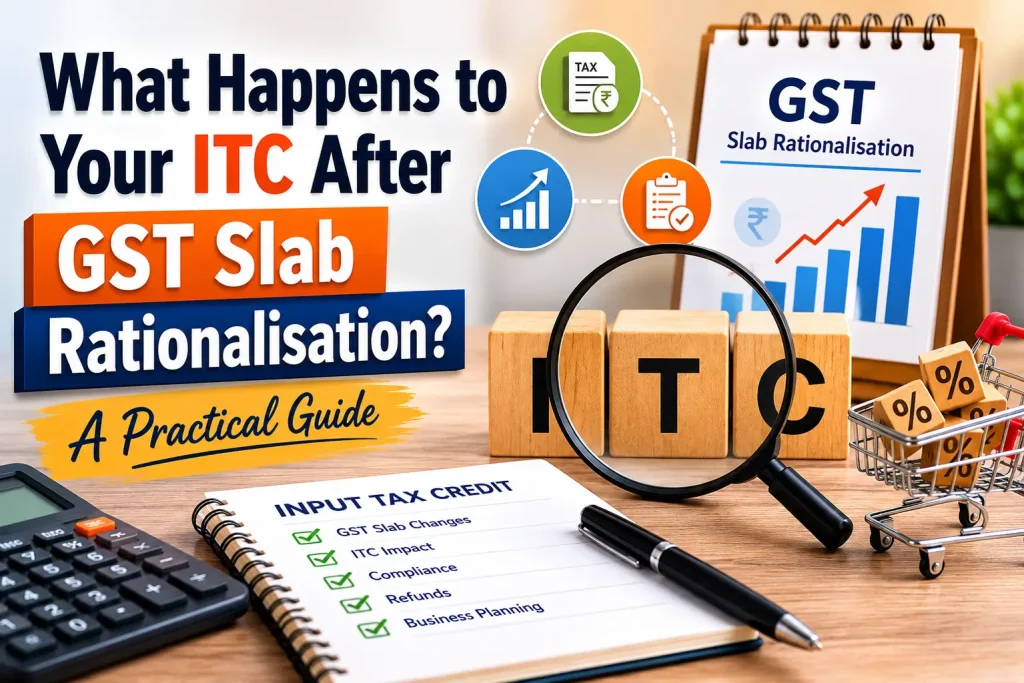
Businesses across India are closely watching every GST update because even a small change in GST slabs can directly impact cash flow, pricing, profitability, and Input Tax Credit management. GST slab rationalisation is one such important topic that taxpayers, traders, manufacturers, service providers, and MSMEs should clearly understand.
Many business owners believe slab rationalisation only affects product prices. In reality, it also creates a major impact on the Input Tax Credit, commonly known as ITC. If businesses fail to manage ITC properly after GST changes, they may face higher tax liability, blocked credits, or compliance notices.
This practical guide explains what happens to your ITC after GST slab rationalisation and how businesses can manage it effectively.
Understanding GST Slab Rationalisation
GST slab rationalisation means the government revises existing GST tax rates to simplify taxation and improve compliance. Some products or services may move from higher slabs to lower slabs, while others may shift to higher tax categories.
For example, a product taxed at 18% may later fall under 12%, or a product taxed at 5% may move to 12%. These changes affect both output tax liability and Input Tax Credit calculations.
Businesses that already claimed ITC on purchases before the revised slab rates may need proper reconciliation to avoid future issues during GST assessments.
Companies seeking support for online GST registration in Ahmedabad should also stay updated with GST notifications because registration and compliance processes are directly connected with ITC eligibility.
What is the Input Tax Credit in GST?
Input Tax Credit allows businesses to reduce the GST paid on purchases from the GST collected on sales. This mechanism prevents double taxation and improves working capital management.
For example, if a business pays GST on raw materials, office expenses, transportation, or professional services, that amount can usually be claimed as ITC against GST payable on sales.
However, ITC is allowed only when certain conditions are fulfilled, such as:
- Valid GST invoice
- The supplier has filed GST returns
- Tax has been paid to the government
- The recipient has received goods or services
- Returns are filed properly
Any mismatch during slab rationalisation can affect ITC claims.
How GST Slab Changes Affect ITC?
When GST rates are revised, businesses may experience several ITC-related changes. These changes depend on stock availability, purchase timing, invoicing date, and revised tax classification.
1. Impact on Existing Stock
Suppose a business purchased stock with 18% GST, and later the product rate became 12%. In such cases, the business may still retain previously claimed ITC if all compliance requirements were correctly fulfilled.
However, businesses should maintain proper documentation of old stock purchases and sales records to avoid departmental disputes.
Many businesses seeking GST Registration Ahmedabad services often require expert guidance for stock reconciliation during GST slab revisions.
2. Accumulation of ITC
When GST rates reduce significantly, businesses may face excess ITC accumulation. This happens because purchases are made at higher GST rates while sales are taxed at lower rates.
For example:
- Purchase GST Rate: 18%
- Sales GST Rate: 5%
In such cases, businesses may accumulate unused ITC balances in their electronic credit ledger.
This situation is common in industries such as textiles, fertilizers, and construction materials where inverted duty structures exist.
Inverted Duty Structure and Refund Issues
An inverted duty structure occurs when the GST rate on inputs is higher than the GST rate on output supplies. Due to slab rationalisation, several industries may experience this problem.
Businesses can apply for ITC refunds under certain conditions. However, refund procedures require proper documentation, invoice matching, and GST return accuracy.
Professional assistance for GST Return Filing Ahmedabad becomes extremely important because refund claims with incorrect data may lead to delays or notices.
Impact on Pricing and Profit Margins
GST slab rationalisation also affects pricing strategies. Businesses often revise product prices after rate changes. However, incorrect ITC treatment may reduce profit margins unexpectedly.
For example, if businesses fail to calculate revised ITC availability correctly, they may underprice products and face working capital shortages later.
Businesses should regularly review:
- Purchase tax rates
- Output tax rates
- ITC eligibility
- Vendor compliance
- Electronic credit ledger balance
This helps in maintaining healthy cash flow and proper tax planning.
Importance of Vendor Compliance
One major challenge after the GST slab changes is vendor mismatch. Even if your business follows all rules, ITC can still get blocked if suppliers fail to file returns properly.
Businesses should continuously verify:
- GSTR 1 filing status
- GSTR 3B compliance
- Invoice matching
- Correct GST rates on invoices
Companies using online GST application in Ahmedabad services should ensure that suppliers also maintain proper GST compliance to avoid ITC reversal risks.
Transitional Challenges During GST Changes
Whenever GST slabs are revised, transitional confusion is very common. Businesses may face issues such as:
- Old invoices with previous GST rates
- Debit note and credit note adjustments
- ERP software updates
- Wrong tax classification
- ITC mismatches in returns
Proper accounting support and GST consultation can help businesses avoid penalties and unnecessary notices.
Maintaining accurate purchase registers and stock records becomes essential during such transitions.
How Businesses Can Protect Their ITC?
Businesses should follow a systematic approach to protect the Input Tax Credit after the GST slab rationalisation.
Maintain Proper Documentation
Keep all GST invoices, e-invoices, purchase records, and stock statements updated and organised.
Reconcile Returns Regularly
Monthly reconciliation between purchase records and GSTR 2B helps identify missing ITC early.
Monitor GST Notifications
GST rules change frequently. Businesses should track official GST updates and notifications regularly.
Review Vendor Compliance
Work only with compliant suppliers who file GST returns on time.
Seek Professional Guidance
GST laws can become technically complex during slab revisions. Professional tax consultants can help businesses manage ITC effectively while maintaining full compliance.
Final Thoughts
GST slab rationalisation is not just about tax rate reduction or increase. It directly impacts Input Tax Credit, cash flow management, pricing strategy, compliance requirements, and business profitability.
Businesses that fail to review ITC implications properly may face blocked credits, excess tax burden, refund delays, or GST notices. On the other hand, businesses with proper planning and compliance can smoothly manage transitions and protect their working capital.
Whether you are a startup, trader, manufacturer, or service provider, proper GST compliance and ITC management are essential for long-term business stability. Taking expert assistance for GST registration, return filing, reconciliation, and compliance can help businesses stay secure and financially efficient in changing GST environments.