GST registration is an important compliance requirement for eligible businesses, but there can be situations where a registration needs to be cancelled. A business may close its operations, change its legal structure, transfer its business, or no longer remain liable for registration. In other cases, the GST registration may be cancelled by the tax officer because of non-compliance or other prescribed reasons.
This is where taxpayers often confuse GST cancellation with GST revocation. Although both terms are related to GST registration, they refer to different processes. Understanding the difference can help businesses take the correct action at the right time.
What Is GST Cancellation?
GST cancellation means bringing a GST registration to an end. Under Section 29 of the CGST Act, registration may be cancelled by the proper officer on their own motion or on an application by the registered person or, in certain cases, legal heirs. Reasons can include closure or transfer of business, change in business constitution, or the taxpayer no longer being liable for registration. The law also provides circumstances where the officer may cancel registration, including certain return filing defaults or registration obtained through fraud, wilful misstatement, or suppression of facts.
Businesses considering GST Cancellation in Ahmedabad should first review their filing position, outstanding liabilities, stock, and other relevant details. Cancellation does not automatically remove tax or other liabilities relating to periods before cancellation.
When Might a Business Need GST Cancellation?
GST cancellation may become relevant when a business permanently stops operations or when its business structure changes. For example, a proprietor may discontinue a business and later start operating through a company or LLP. Similarly, a business may be transferred to another taxpayer, or there may be a duplicate or incorrectly obtained registration.
The GST registration rules also provide for cancellation applications and require relevant details, including information relating to stock and liabilities, to be furnished as applicable.
Before applying, businesses should review pending returns and tax dues. GST Cancellation Services in Ahmedabad can be useful when a taxpayer needs assistance with documentation, application filing, department communication, and post-cancellation requirements.
What Is GST Revocation?
GST revocation is different from cancellation. It refers to restoring a GST registration that has been cancelled by the proper officer on their own motion, subject to the applicable conditions.
Section 30 of the CGST Act provides for an application for revocation of cancellation, subject to prescribed conditions. The application is generally required within the prescribed period from the date of service of the cancellation order, with provisions allowing specified extensions.
Therefore, revocation is not a separate type of GST registration. It is a process through which an eligible taxpayer seeks restoration of a registration that was cancelled by the officer.
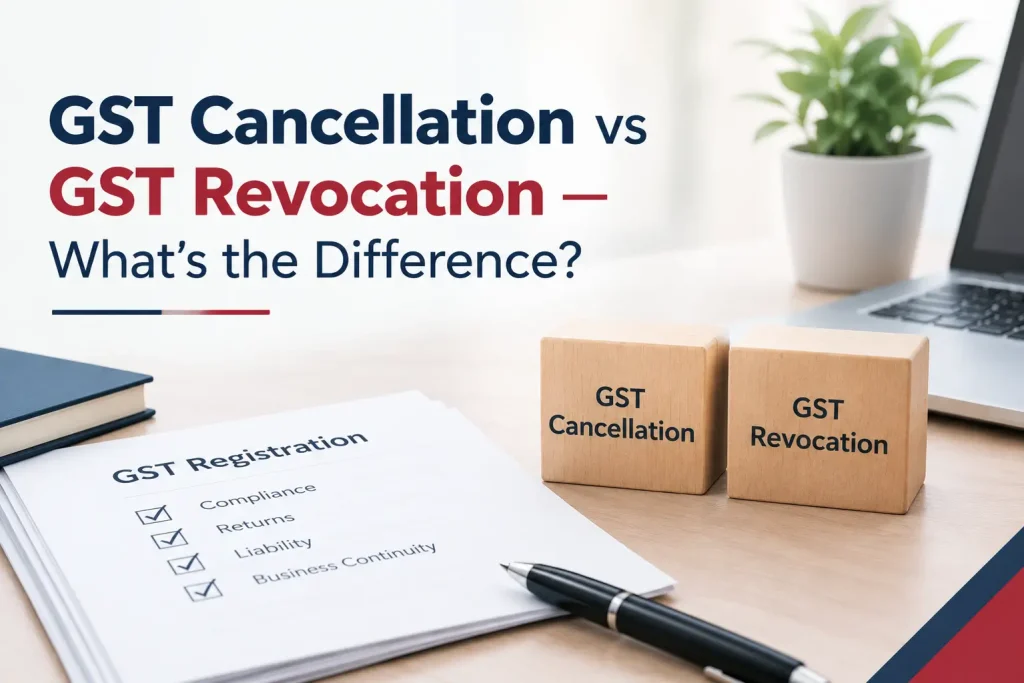
GST Cancellation vs GST Revocation
The basic difference can be understood easily. Cancellation ends the GST registration, while revocation is used to restore an eligible registration after it has been cancelled by the proper officer.
For example, if a business has genuinely stopped operations and no longer needs its GST registration, cancellation may be appropriate. On the other hand, if the registration was cancelled by the department because of return filing defaults and the business wants to continue operations, the taxpayer may need to consider GST Revocation Services in Ahmedabad, subject to the applicable legal conditions.
It is important not to treat these processes as interchangeable because the correct procedure depends on why and how the registration was cancelled.
What Happens When Registration Is Cancelled for Non-Filing?
Failure to file GST returns can be one of the circumstances leading to cancellation by the proper officer. Section 29 specifically provides for cancellation in certain cases involving continuous return defaults.
For revocation applications involving cancellation due to failure to furnish returns, the applicable rules require the pending returns to be furnished and the relevant tax, interest, penalty, and late fee liabilities to be paid before the revocation application can be filed.
This makes it important for businesses to address their pending compliance before seeking restoration.
How Does the Revocation Process Work?
When a taxpayer is eligible to seek revocation, the application is submitted through the GST portal in the prescribed form and within the applicable time limit. The proper officer reviews the application and may either approve the revocation or reject it for reasons permitted under the law.
Where the officer proposes to reject the application, the taxpayer is given an opportunity to respond according to the prescribed procedure.
A taxpayer should therefore carefully review the cancellation order, identify the reason for cancellation, and resolve the underlying compliance issue before applying for revocation.
Keep Your GST Records Updated
Whether a business is applying for cancellation or trying to restore a cancelled registration, proper records are important. Businesses should maintain GST returns, invoices, purchase records, sales records, payment details, tax calculations, and other supporting documents in an organised manner.
Regular compliance can also reduce the possibility of cancellation arising from avoidable filing defaults. A GST Consultant Ahmedabad can assist businesses with reviewing their GST position, identifying pending compliance and preparing the necessary documentation.
When Should You Seek Professional Assistance?
GST cancellation and revocation involve specific forms, documentation, timelines, and compliance requirements. A mistake in selecting the reason, preparing information, or responding to a departmental communication can lead to delays.
DP Tax Experts provides GST cancellation and revocation assistance in Ahmedabad, including eligibility assessment, documentation support, application filing, follow-up with tax authorities, and post-cancellation compliance. The firm’s GST services also include GST registration, GST returns, GST annual returns, and other GST-related compliance services.
Final Thoughts
GST cancellation and GST revocation serve two different purposes. Cancellation brings a GST registration to an end, while revocation provides a mechanism to seek restoration when a registration has been cancelled by the proper officer and the taxpayer meets the applicable conditions.
Before taking any action, businesses should understand the reason for cancellation, check pending returns and liabilities, review the applicable timelines, and maintain proper supporting documents. Getting professional guidance can help ensure that the correct GST procedure is followed and that avoidable compliance issues are addressed properly.