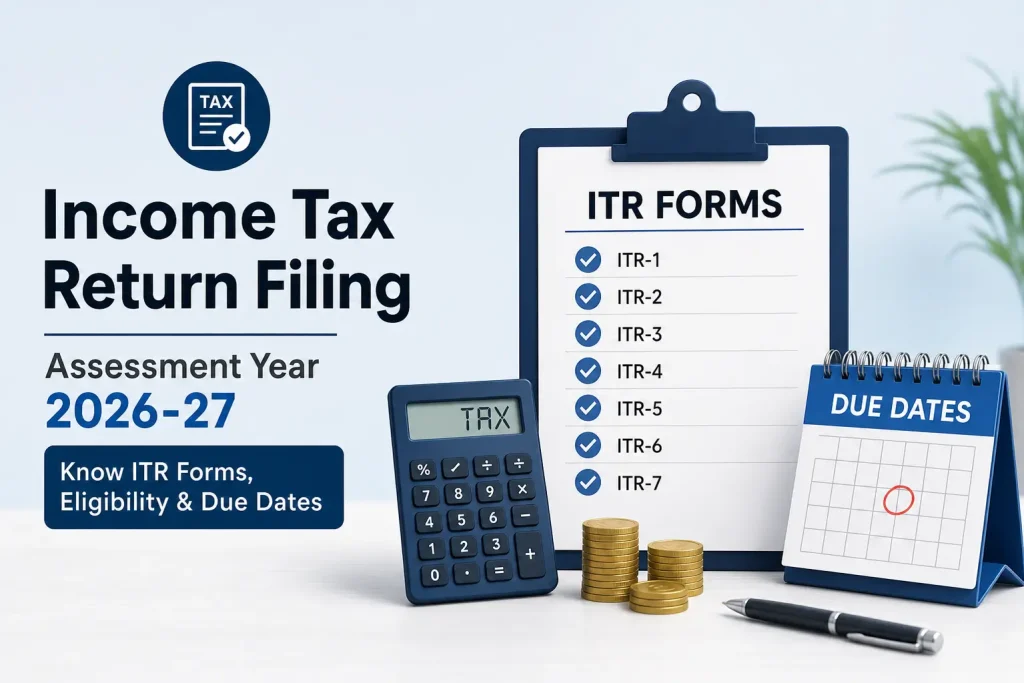
Filing your Income Tax Return Filing correctly is not just a legal requirement but also an essential financial responsibility. For the Assessment Year (AY) 2026–27, the Income Tax Department has clearly defined different ITR forms based on income type, taxpayer category, and financial complexity. Choosing the correct form is crucial, as filing the wrong one can result in defective return notices and delays in processing.
In this guide, we simplify everything you need to know about ITR filing in India, along with eligibility criteria, restrictions, and due dates.
Why Choosing the Right ITR Form Matters?
Many taxpayers assume that filing any ITR form is acceptable as long as they report income. However, this is not true. Each form is designed for a specific category of taxpayers. Selecting the wrong form can lead to:
- Rejection of your return
- Notice from the Income Tax Department
- Delays in refunds
- Penalties or compliance issues
Understanding the correct form ensures smooth and hassle-free filing.
ITR Forms for Individuals
1. ITR-1 (SAHAJ)
ITR-1 is the simplest form, ideal for salaried individuals with straightforward income sources.
Eligibility:
- Resident individuals only
- Total income up to ₹50 Lakhs
- Income from salary/pension
- Income from up to two house properties
- Interest income
- Agricultural income up to ₹5,000
New Update:
- Long-Term Capital Gains (LTCG) under Section 112A up to ₹1.25 Lakhs are now allowed
This form is best suited for individuals looking for a simple income tax return filing process.
2. ITR-2
ITR-2 is for individuals and Hindu Undivided Families (HUFs) with more complex financial profiles.
Eligibility:
- Income exceeding ₹50 Lakhs
- Capital gains (short-term or long-term)
- More than two house properties
- Foreign income or assets
Note:
This form cannot be used if you have income from a business or profession.
3. ITR-3
ITR-3 is designed for individuals and HUFs earning income from business or profession.
Eligibility:
- Proprietary business owners
- Freelancers and professionals
- Income from trading, consultancy, or professional services
If you run a business or are self-employed, this form is mandatory for accurate ITR filing in India compliance.
4. ITR-4 (SUGAM)
ITR-4 is for taxpayers opting for the Presumptive Taxation Scheme under Sections 44AD, 44ADA, or 44AE.
Eligibility:
- Individuals, HUFs, and firms (excluding LLPs)
- Total income up to ₹50 Lakhs
- Income calculated on a presumptive basis
This form simplifies tax calculations for small businesses and professionals.
ITR Forms for Non-Individual Entities
5. ITR-5
Applicable for:
- LLPs
- Association of Persons (AOPs)
- Body of Individuals (BOIs)
- Business trusts and investment funds
6. ITR-6
Used by:
- Companies not claiming exemption under Section 11
7. ITR-7
Applicable for:
- Trusts
- Charitable institutions
- Non-profit organisations
- Entities required to file under specific sections
Restrictions for Simplified Forms (ITR-1 & ITR-4)
While ITR-1 and ITR-4 are simplified forms, they come with certain restrictions. You cannot use these forms if:
- You are a company director
- You hold unlisted equity shares
- You have foreign assets or foreign income
- You have an ESOP-related deferred tax liability
- You are subject to TDS under Section 194N
In such cases, you must choose a more detailed ITR form to avoid compliance issues.
Special Purpose Forms You Should Know
ITR-V (Verification Form)
If you file your return electronically without a digital signature and do not complete e-verification, you must submit ITR-V to validate your return.
ITR-U (Updated Return)
ITR-U allows taxpayers to update previously filed returns within 48 months from the end of the relevant assessment year.
Use Cases:
- Correcting errors
- Reporting missed income
- Updating incomplete details
However, filing an updated return requires payment of additional tax and penalties.
Important Due Dates for AY 2026–27
Timely filing is essential to avoid penalties and interest charges. Here are the key deadlines:
- 31st July 2026 – Individuals and non-audit cases
- 31st August 2026 – Non-audit business and professional cases
- 31st October 2026 – Audit cases
Missing these deadlines may result in late filing fees and loss of certain benefits like carrying forward losses.
Final Thoughts
Filing your Income Tax Return Filing correctly for AY 2026–27 requires a clear understanding of applicable forms, eligibility, and compliance rules. Whether you are a salaried individual, a business owner, or a company, choosing the right ITR form is the first and most crucial step.
If your financial situation is complex or you are unsure about the correct form, consulting a professional tax expert can help you avoid costly mistakes and ensure smooth processing.
Stay compliant, file on time, and make your tax journey stress-free!