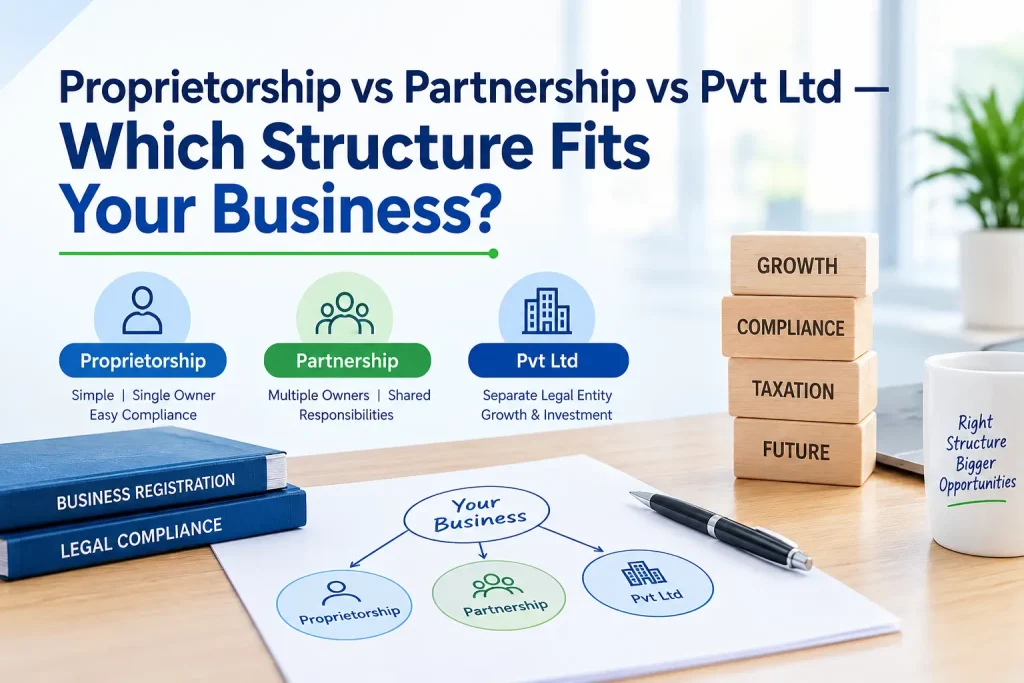
Choosing the right business structure is an important decision for any entrepreneur in India. The structure you select can affect ownership, liability, taxation, compliance requirements, funding opportunities, and the way your business grows. Three common options are proprietorship, partnership, and private limited company.
There is no single structure that suits every business. A small individual business may prefer a simple setup, while businesses started by two or more people may consider a partnership. Businesses planning expansion, external investment, or a more structured corporate setup may consider a private limited company.
What Is a Proprietorship?
A proprietorship is one of the simplest business structures in India. It is owned and managed by a single individual, and there is no separate legal identity between the owner and the business. This structure is commonly used by freelancers, consultants, traders, retailers, and small service providers.
One of the key advantages is comparatively simple administration. The owner can manage business operations directly without the corporate compliance requirements applicable to a company. Entrepreneurs looking for Proprietorship Registration Services Ahmedabad can get assistance with setting up the required registrations and business documentation.
A proprietorship can be suitable when the business is relatively small, the owner wants direct control, and there is no immediate requirement for multiple owners or external equity investment.
What Is a Partnership Firm?
A partnership is generally formed when two or more people agree to carry on a business and share its profits according to the agreed terms. The rights, responsibilities, profit-sharing arrangement, and other important matters are normally documented through a partnership deed.
A partnership allows business owners to combine their capital, knowledge, skills, and networks. It can therefore be useful for businesses where two or more individuals want to work together while maintaining a relatively straightforward business structure.
Entrepreneurs considering partnership firm registration in Ahmedabad should carefully define the roles of partners, capital contributions, profit sharing, decision-making, and procedures for adding or exiting partners in the partnership deed.
What Is a Private Limited Company?
A private limited company is a separate legal entity incorporated under the Companies Act, 2013. It has shareholders and directors, with ownership represented through shares. This structure is commonly considered by businesses planning organised expansion, multiple stakeholders, or potential investment.
A private limited company provides limited liability to its shareholders, subject to applicable legal provisions. It also has a more structured framework for governance, financial records, and regulatory compliance.
Businesses planning Private Limited Company Registration should consider their expected ownership structure, capital requirements, management responsibilities, and ongoing compliance before incorporation.
Key Differences Between the Three Structures
The main difference between proprietorship, partnership, and private limited company is the level of ownership structure, liability, and compliance.
A proprietorship has one owner and offers direct control with comparatively simpler administration. A partnership allows multiple partners to jointly operate a business under agreed terms. A private limited company creates a separate legal entity with shareholders and directors.
The compliance burden also generally increases as the business structure becomes more formal. A private limited company normally involves regular corporate and statutory compliance, while a proprietorship can have fewer entity-level formalities.
Liability is another important consideration. In a proprietorship, the business and owner are not separate legal persons. In a traditional partnership, partners can have personal liability for the firm’s obligations, subject to applicable law and circumstances. A private limited company generally provides a separate legal identity and limited liability framework.
Which Structure Is Suitable for a Small Business?
For an individual starting a small trading or service business, a proprietorship can be considered when simplicity and direct ownership are priorities. Businesses can explore Small Business Registration Ahmedabad options based on their activities and applicable registration requirements.
However, the choice should also consider future plans. If the business may soon require another owner, formal investment, or a different legal structure, it can be useful to consider these requirements before registration.
When Should You Consider a Partnership?
A partnership can be considered when two or more individuals want to operate a business together and share responsibilities. It can be useful where the partners bring different skills, capital, or business relationships.
Before selecting this structure, partners should clearly discuss how profits and losses will be shared, who will manage daily operations, and what will happen if a partner wants to leave the business.
For businesses that later require a different structure, business conversion services in Ahmedabad can help with understanding the applicable conversion process and documentation.
When Can a Private Limited Company Be Considered?
A private limited company may be considered when entrepreneurs want a formal corporate structure and are planning for business expansion. It can also be relevant where the business expects multiple shareholders or wants to create a structured ownership model.
The company structure involves greater compliance responsibilities, including applicable filings and maintenance of statutory records. Therefore, entrepreneurs should consider both the benefits and ongoing obligations before incorporation.
Can You Change Your Business Structure Later?
Business requirements can change as the company grows. An entrepreneur may initially operate as a proprietorship and later explore another structure because of expansion, ownership requirements, or investment plans.
For example, a business may consider proprietorship to private limited company in India when its operational and ownership requirements change. The applicable process depends on the existing structure, proposed structure, business assets, registrations, and legal requirements.
It is therefore useful to review the structure periodically instead of assuming that the original choice will remain suitable throughout the entire business journey.
Conclusion
Proprietorship, partnership and private limited company each have different characteristics. Proprietorship can offer simplicity and direct control for an individual owner. Partnership can support businesses operated jointly by multiple individuals. A private limited company can provide a formal corporate framework for businesses planning structured growth and multiple shareholders.
Before selecting a structure, entrepreneurs should consider ownership, liability, compliance, taxation, funding requirements, business size, and long-term plans. Professional guidance can help business owners understand the applicable requirements and choose a structure based on their specific circumstances.